Seamless Geometrical Patterns: The Quiet Engine Powering Modern Creative Workflows
In today’s accelerated creative economy—where speed, scalability, and visual consistency are non-negotiable—Seamless Geometrical Patterns have evolved from a niche design technique into a foundational asset class. No longer confined to textile studios or vintage wallpaper archives, these precision-engineered motifs now fuel everything from high-volume POD (print-on-demand) product lines to responsive website interfaces, digital album layouts, and even micro-design applications like nail wraps and jewelry engravings. What makes them indispensable isn’t just their aesthetic clarity—but their structural intelligence: each pattern repeats flawlessly across any surface, at any scale, without visible seams, distortion, or pixelation.
What Exactly Are Seamless Geometrical Patterns?
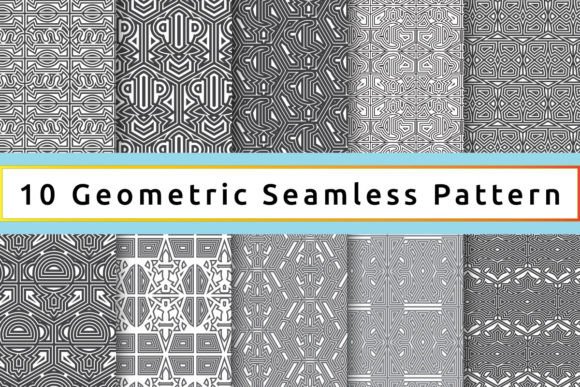
Seamless Geometrical Patterns are vector- and raster-based designs composed of mathematically aligned shapes—triangles, hexagons, tessellating polygons, grids, lattices, and parametric curves—that tile infinitely in two dimensions. Unlike decorative illustrations or photographic textures, their geometry is algorithmically coherent: the right edge of the tile matches the left; the top aligns perfectly with the bottom. This technical rigor enables true scalability and adaptability—critical when a single motif must render crisply on a 4” smartphone case, a 36” wall mural, or a 0.5mm laser-etched pendant.
Crucially, “seamless” here is not just a visual descriptor—it’s a functional guarantee. Each file in our collection is built to industry standards: 300 DPI resolution, production-ready EPS (for infinite vector scaling), high-fidelity JPG (for fast web integration), and transparent-background PNG (for layered digital compositing). These aren’t decorative afterthoughts—they’re engineered assets designed for deployment.
Bridging Design, Technology, and Market Demand
The rise of Seamless Geometrical Patterns reflects deeper shifts across creative industries. First, the explosion of print-on-demand platforms has transformed how designers monetize work. Entrepreneurs no longer need inventory or screen-printing setups to launch T-shirt lines, phone covers, or stationery collections. Instead, they rely on adaptable, resolution-agnostic assets that integrate seamlessly into automated workflows. A single Seamless Geometrical Pattern can be uploaded once and instantly applied across dozens of SKUs—reducing time-to-market from weeks to minutes.
Second, digital-first consumption habits demand visual cohesion across fragmented touchpoints. A brand’s identity must hold up equally well on an Instagram story background, a limited-edition magnet set, a PDF wedding invitation suite, and a Shopify homepage banner. Geometric patterns—especially those rooted in symmetry, rhythm, and proportion—provide that unifying visual language. Their neutrality and modularity make them ideal for establishing tone without overwhelming content—a subtle but powerful advantage in attention-scarce environments.
Third, tools like Figma, Adobe Express, and Canva have democratized layout design—but they’ve also raised expectations for polish and professionalism. Users now expect drag-and-drop elements that behave predictably: no awkward cropping, no misaligned repeats, no fuzzy edges when zoomed. That’s where rigorously constructed seamless files deliver measurable ROI—not as “pretty graphics,” but as operational reliability.
Real-World Applications: Beyond Aesthetics
Consider these practical deployments—each grounded in real workflow needs:
- T-Shirt & Apparel Design: A hexagonal tessellation pattern scales cleanly across chest prints, all-over dye-sublimation, and sleeve accents—no manual tiling or edge correction required.
- Website & App UI Backgrounds: Subtle geometric grids add depth and structure to hero sections or dashboard cards without competing with text or interactive elements.
- Digital Albums & Social Templates: PNG files with transparency let creators overlay patterns on photos, quotes, or video thumbnails—enhancing visual hierarchy while preserving legibility.
- Nail Wraps & Micro-Prints: High-DPI JPG and PNG variants ensure crisp reproduction even at sub-centimeter dimensions—critical when detail fidelity impacts perceived quality.
- Jewelry & Laser-Cut Crafts: EPS vector files translate directly into CNC paths or engraving software, enabling precise replication on metal, wood, or acrylic surfaces.
These aren’t hypothetical use cases. They reflect documented behavior: designers reporting 30–50% faster mockup iteration when using pre-aligned seamless assets, marketers observing higher engagement on social posts featuring structured geometric backdrops, and POD sellers citing fewer customer complaints about print alignment after switching to rigorously tested seamless files.
Why Now? The Convergence of Precision, Accessibility, and Expectation
Three interlocking developments explain why Seamless Geometrical Patterns are gaining strategic importance:
- Computational Literacy Is Rising: More creators understand the difference between raster and vector, DPI and PPI, and why tile boundaries matter. They don’t just want “cool shapes”—they want assets that behave correctly inside their tools.
- Consumer Expectations Are Sharper: Audiences notice inconsistencies. A misaligned repeat on a tote bag, a blurry corner on a digital card, or a visible seam in a website background erodes trust in a brand’s attention to detail—even if unconsciously.
- Production Ecosystems Are Standardized: From Etsy’s image guidelines to Printful’s template specs and Canva’s asset library requirements, platforms increasingly reward technical compliance. Seamless Geometrical Patterns meet those standards by design—not as an exception, but as a baseline.
This isn’t about chasing trends. It’s about aligning with infrastructure. When your workflow involves exporting assets for multiple outputs—whether for physical goods, digital publishing, or embedded interfaces—starting with a structurally sound foundation eliminates downstream friction. It turns what used to be a manual, error-prone step (tiling, masking, resampling) into an automated, repeatable action.
Design Integrity Meets Business Agility
For professionals, the value proposition extends beyond convenience. Using rigorously crafted Seamless Geometrical Patterns signals design maturity. It tells clients and collaborators that you prioritize craft *and* efficiency—that you understand how visual decisions propagate across systems. For freelancers building scalable service packages, these assets become reusable components: a branded pattern library that accelerates client onboarding and ensures visual continuity across deliverables.
For entrepreneurs, they reduce risk. Instead of commissioning custom patterns for every new product line, you invest once in a versatile, high-quality set—then iterate rapidly based on real-time market feedback. One designer recently launched a capsule collection of minimalist magnets and paper crafts using a single geometric lattice file; after validating demand, she extended the same pattern to enamel pins and ceramic coasters—without redesigning a single element.
And for marketers, these patterns support agile experimentation. Need a refreshed email header? Swap in a new seamless background. Launching a holiday campaign? Apply the same motif across banners, social posts, and printable gift tags—with consistent spacing, contrast, and scale. Consistency becomes operational—not aspirational.
Final Thought: Precision as a Creative Partner
Seamless Geometrical Patterns represent a quiet but significant shift: away from treating design assets as static decorations, and toward recognizing them as intelligent, interoperable components of a larger system. They don’t replace creativity—they extend it. They don’t eliminate decision-making—they remove unnecessary variables, freeing mental bandwidth for higher-order choices: messaging, audience resonance, emotional tone.
Whether you're developing a signature product line, building a cohesive brand ecosystem, or crafting digital experiences that feel both modern and trustworthy, starting with technically sound, context-aware assets isn’t an indulgence—it’s infrastructure. Our collection delivers exactly that: unique designs, built for real-world use, optimized for 300 DPI output, and available in EPS, JPG, and PNG formats—ready to integrate, adapt, and scale.
Thanks for visiting our store. We build these patterns with care—and we welcome your feedback as you put them to work in your projects.