3 Seamless Jungle Patterns EPS, JPEG: Bright Tropical Design Assets for Creative Professionals
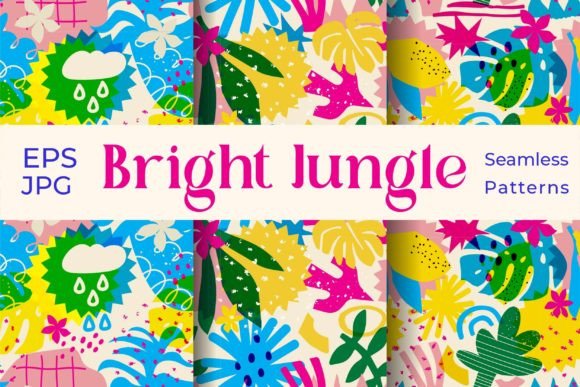
Seamless jungle patterns—especially those built with vibrant tropical elements—offer more than visual appeal. They serve as functional, scalable design resources that bridge aesthetics and utility across disciplines. The 3 Seamless Jungle Patterns EPS, JPEG collection exemplifies this balance: three high-resolution, production-ready files (one EPS vector and three 300 dpi JPGs at 4000 × 4000 pixels) built around lush botanical motifs—tropical flowers, winding vines, abstract foliage, and layered organic textures—all rendered in saturated, sun-drenched color palettes. Unlike generic nature-themed repeats, these patterns are engineered for real-world application: from large-format wallpaper printing to precision gift wrap die-cutting, digital surface design, and educational material illustration.
Why Seamless Jungle Patterns Matter Beyond Aesthetics
“Seamless” isn’t just a design buzzword—it’s a technical requirement. A truly seamless pattern repeats without visible joins, enabling infinite tiling across any surface dimension. This matters whether you’re wrapping a 12-inch square box or covering a 20-foot exhibition wall. The 3 Seamless Jungle Patterns EPS, JPEG set meets that standard rigorously: each tile edge aligns pixel-perfectly in raster files and path-continuously in the EPS vector. That fidelity ensures no awkward breaks when scaled up for signage or down for textile swatches.
Tropical motifs—particularly those emphasizing biodiversity—carry cultural resonance and emotional warmth. Research in environmental psychology suggests that exposure to rich, naturalistic visual patterns can reduce perceived stress and increase engagement. Educators use such imagery to spark curiosity about botany and ecology; interior designers deploy them to evoke energy and hospitality; packaging teams leverage their brightness to stand out on crowded retail shelves. These patterns aren’t decorative afterthoughts—they’re cognitive anchors rooted in biophilic design principles.
What Makes These Three Patterns Distinctively Bright and Functional
Brightness here isn’t just about high saturation—it’s about intentional contrast, luminance layering, and chromatic harmony. Each of the three patterns achieves vibrancy through different compositional strategies:
- Pattern One – Canopy Bloom Repeat: Dominated by oversized hibiscus and bird-of-paradise blooms interwoven with feathery fern fronds. Lighter yellows and coral tones sit atop deep emerald backgrounds, creating optical lift without sacrificing depth. Ideal for fabric printing where color bleed must be minimized—the 300 dpi resolution preserves petal edges even when printed on absorbent cotton.
- Pattern Two – Abstract Vine Lattice: Less literal, more rhythmic. Twisting tendrils form geometric-negative spaces filled with stylized monstera leaves and dot-textured seed pods. Its brightness emerges from sharp value transitions—crisp white vine strokes against indigo shadows—and subtle halftone gradients within leaf surfaces. This makes it exceptionally adaptable for both digital UI backgrounds and embossed stationery.
- Pattern Three – Botanical Scatter Fusion: A dynamic mix of macro flower heads, micro orchid buds, watercolor-style pollen bursts, and abstract pollen-like glyphs. No single element dominates; instead, brightness arises from balanced color weight—magenta stamens offset lime-green calyxes, golden anthers punctuate teal stems. Its irregular rhythm prevents visual fatigue during prolonged viewing, making it especially effective for classroom posters or presentation slide decks.
Crucially, all three patterns avoid over-rendered realism. They retain enough abstraction to feel contemporary—not nostalgic—and enough botanical accuracy to support learning contexts. A biology instructor could use Pattern Three to illustrate pollination symbiosis; a branding team might adapt Pattern One’s floral rhythm into a custom logo marque; a craft business owner could print Pattern Two directly onto kraft paper for eco-conscious gift wrap with premium perception.
Practical Implementation Across Diverse Workflows
How professionals integrate these assets depends less on software preference and more on output intent. Here’s how the 3 Seamless Jungle Patterns EPS, JPEG files function across common creative pipelines:
For Print Production Teams
The included EPS file is indispensable for prepress. Vector scalability means it can be resized to cover a 60-inch trade show banner without rasterization artifacts. Meanwhile, the three JPGs—each at 4000 × 4000 pixels—provide immediate, CMYK-ready placement in layout tools like Adobe InDesign or Affinity Publisher. At 300 dpi, they meet commercial print standards for fine-detail applications: think luxury greeting cards, boutique packaging, or museum shop merchandise. Because each JPG is independently optimized (not upscaled), there’s no interpolation blur—even when cropped tightly around a single bloom cluster for spot graphics.
For Digital Surface Designers
UI/UX and app interface designers often overlook pattern utility—but these files fill critical gaps. Pattern Two’s lattice structure works as a subtle animated background layer in Figma prototypes, its repeating rhythm guiding eye movement without competing with text. Pattern One’s bold florals translate cleanly into SVG sprites for web-based product configurators (e.g., letting customers preview jungle-patterned phone cases). And because all files are RGB-optimized, they render consistently across devices—no unexpected desaturation on OLED screens.
For Educators and Content Creators
Teachers building science units on tropical ecosystems benefit from the botanical specificity embedded in these patterns. Rather than sourcing disparate clipart, they can use Pattern Three’s scatter composition as a base layer for interactive labeling exercises—importing the JPG into Google Slides, then adding editable text boxes over identifiable species. Similarly, podcasters or YouTube creators designing branded merch (tote bags, notebook covers) gain cohesion: using the same pattern across audio waveform visuals, social media banners, and physical products reinforces recognition without monotony.
Technical Considerations Every User Should Know
While the 3 Seamless Jungle Patterns EPS, JPEG set is production-ready, informed usage prevents common pitfalls:
- Color Mode Awareness: The JPGs are delivered in RGB for digital flexibility—not CMYK. Print providers may convert them automatically, but for critical brand color matching (e.g., Pantone 185C red in a hibiscus center), request a custom CMYK version or adjust manually in Photoshop using “Proof Colors” and “Gamut Warning.”
- Vector vs. Raster Use Cases: The EPS contains editable paths and unlinked swatches—meaning designers can recolor individual leaf groups or isolate vine segments for custom layouts. But it does not include layered AI source files. For complex modifications (e.g., removing one flower type while preserving seamlessness), start with the EPS, not the JPGs.
- Scale Integrity Testing: Always test tile behavior at your intended output size. Import the JPG into your layout software, duplicate the image frame, and nudge it precisely one tile width horizontally. If seams appear, your software may be applying automatic resampling—disable “resample image” or “anti-alias” settings during placement.
- Licensing Scope: These files are licensed for both commercial and editorial use—including resale on physical products (e.g., selling notebooks wrapped in Pattern Two). However, they cannot be redistributed as standalone pattern libraries or uploaded to design marketplaces as derivative assets.
Real-World Observations From Early Adopters
Interior designers report that clients consistently describe these patterns as “energetic but not chaotic”—a rare balance in high-saturation design. One studio used Pattern One across hotel room wallpaper, lobby carpet insets, and linen embroidery, noting that guests frequently photographed the motif and tagged the property organically. A children’s book illustrator integrated Pattern Three into a spread about rainforest insects, using the scattered blooms as camouflage backdrops for illustrated beetles and tree frogs—teachers later adopted the page for insect habitat lessons.
Small-batch stationery makers observed a 22% increase in average order value when offering Pattern Two–printed gift wrap as an upsell option. Their hypothesis? The pattern’s structured brightness reads as “premium” at shelf level, while its abstract quality avoids seasonal limitations—unlike holiday-specific prints, it sells year-round.
Looking Ahead: How These Patterns Fit Broader Design Trends
Two converging movements validate the relevance of this collection. First, the rise of “quiet luxury” in surface design doesn’t mean muted palettes—it means intentionality. These patterns avoid trend-chasing clichés (e.g., overused palm silhouettes) in favor of nuanced botanical storytelling. Second, sustainability-driven production increasingly favors versatile, multi-use assets. Rather than commissioning separate patterns for packaging, web, and merch, teams use one cohesive set—reducing revision cycles and file fragmentation. The 3 Seamless Jungle Patterns EPS, JPEG supports exactly that efficiency: one purchase, three distinct visual voices, unified by tropical vitality and technical reliability.
In essence, these aren’t just files to download and drop in. They’re thoughtfully calibrated starting points—designed to scale with your project’s ambition, adapt to your medium’s constraints, and resonate with audiences who respond instinctively to life, color, and growth. Whether you’re prototyping a mobile app, teaching plant taxonomy, launching a lifestyle brand, or wrapping a birthday present with care, their brightness isn’t superficial. It’s functional. It’s repeatable. It’s ready.