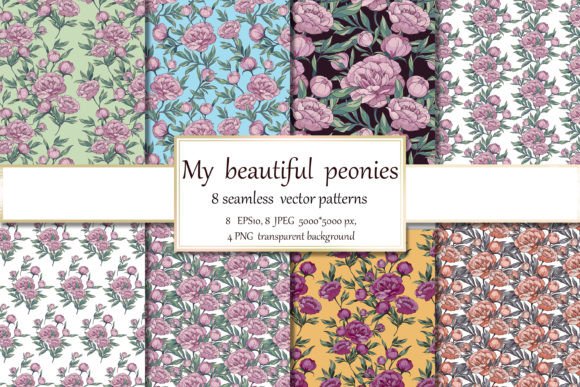
Peonies, 8 Floral Seamless Patterns: A Versatile Design Resource for Creative Professionals and Enthusiasts
Peonies have long symbolized prosperity, romance, and refined elegance across cultures—from traditional Chinese ink paintings to Victorian-era botanical illustrations. Their lush, layered petals and soft seasonal presence make them perennial favorites in visual storytelling. When translated into digital design assets, peonies retain that expressive richness—especially when captured in a thoughtfully curated set like Peonies, 8 Floral Seamless Patterns. This collection goes beyond generic floral motifs: it offers eight distinct, hand-drawn seamless patterns rooted in botanical accuracy and artistic intentionality. Each pattern integrates peony blooms, delicate buds, and complementary foliage, rendered with attention to proportion, gesture, and natural growth rhythm.
Why Seamless Patterns Matter in Modern Design Workflows
Seamless patterns are foundational tools—not decorative afterthoughts. They enable designers to tile artwork infinitely without visible breaks or repetition artifacts, making them indispensable for scalable applications like fabric printing, packaging backgrounds, web page textures, and large-format wall graphics. Unlike raster-only assets, the Peonies, 8 Floral Seamless Patterns collection delivers both vector and high-resolution raster formats, ensuring fidelity at any size—from a business card border to a 10-foot event backdrop. The inclusion of EPS10 vector files means designers can adjust colors, isolate individual elements, or modify stroke weights without degradation—a critical advantage when adapting designs for brand guidelines or accessibility requirements.
Design Integrity Through Hand-Drawn Authenticity
While algorithm-generated florals often sacrifice nuance for uniformity, this collection prioritizes human-led artistry. Each peony was drawn by hand before digitization, preserving subtle variations in petal curvature, stamen density, and leaf venation. That authenticity translates directly into visual trustworthiness: viewers subconsciously recognize organic irregularity as credible and emotionally resonant. For educators teaching botanical illustration or designers crafting luxury branding, such fidelity supports narrative depth. A wedding invitation using one of these patterns doesn’t just look “pretty”—it evokes seasonality, care, and craftsmanship. Similarly, a university’s sustainability campaign might use the green-background pattern to subtly reinforce themes of growth and renewal without overt symbolism.
Background Variations: Strategic Color Application
The eight patterns are distributed across four carefully chosen background tones—blue, yellow, green, and white—each serving distinct functional and psychological purposes:
- Blue backgrounds convey calm, professionalism, and timelessness—ideal for corporate stationery, healthcare communications, or academic publications where clarity and restraint are valued.
- Yellow backgrounds introduce warmth and energy without overwhelming; they work especially well for children’s educational materials, boutique packaging, or summer-themed digital content.
- Green backgrounds support eco-conscious branding, wellness platforms, and garden-related enterprises—leveraging color psychology to reinforce environmental alignment.
- White backgrounds maximize versatility for print production, offering clean separation for spot-color printing or easy layering in multi-element layouts.
This intentional palette diversity eliminates the need for time-consuming recoloring in post-production—saving hours across iterative design phases.
Practical File Specifications and Cross-Platform Utility
The technical execution matches its creative ambition. Users receive:
- Eight EPS10 vector files—fully editable in Adobe Illustrator, Affinity Designer, CorelDRAW, and other vector-compatible software. These allow infinite scaling, path manipulation, and CMYK/RGB conversion without quality loss.
- Eight JPEG files (5000 × 5000 pixels, 300 DPI)—optimized for high-fidelity print output, including greeting cards, wrapping paper, and fine-art prints.
- Four PNG files with transparent backgrounds—designed for web overlays, social media banners, UI elements, and layered digital compositions where background independence is essential.
This tri-format structure bridges gaps between disciplines. A textile designer can import the EPS into pattern-making software to adjust repeat units; a blogger can drop a transparent PNG over a hero image for subtle texture; a small-batch candle maker can apply the JPEG to label templates knowing it will hold crisp detail at 300 DPI. No single file type dominates—the collection anticipates real-world constraints and toolchains.
Real-World Applications Across Industries
The adaptability of Peonies, 8 Floral Seamless Patterns emerges most clearly through applied use cases:
- Event Planning & Stationery: Wedding designers use the white-background pattern for save-the-date cards and menu inserts, while the blue variant anchors elegant escort cards. The seamless nature ensures no awkward edge cuts when trimming custom die-cut shapes.
- Educational Materials: Biology teachers incorporate the botanical accuracy of buds and leaves into plant-life-cycle posters. The consistent scale across all eight patterns allows side-by-side comparison of developmental stages.
- Packaging & Product Design: Skincare brands select the green-background pattern for eco-labeled serums, reinforcing ingredient sourcing narratives. Its seamless flow guides the eye naturally around cylindrical containers.
- Digital Platforms: Bloggers integrate the transparent PNGs as subtle hover effects on navigation menus or as textured dividers between content sections—enhancing visual hierarchy without competing with text.
- Scrapbooking & Paper Crafts: Hobbyists print the JPEGs onto specialty papers—vellum, kraft, or metallic stock—and cut them into custom washi tapes or layered die-cut accents.
- Fabric & Surface Design: Independent apparel designers scale the EPS files to match garment grain lines, then export for digital textile printing—ensuring peony motifs align precisely across seams and hems.
Considerations for Ethical and Effective Implementation
Even high-quality resources require thoughtful deployment. Designers should consider context before applying floral patterns. Overuse—especially at full opacity—can reduce readability in text-heavy layouts. Best practice involves adjusting layer opacity (e.g., 8–12% for subtle texture), using clipping masks to confine patterns to specific zones, or pairing with ample negative space. Additionally, cultural associations matter: while peonies signify honor in China, they carry connotations of bashfulness in some Western contexts—making them especially fitting for modest branding or sensitive communications.
Accessibility also plays a role. When using colored backgrounds, verify contrast ratios against foreground text using tools like WebAIM’s Contrast Checker. The white-background files offer the broadest compatibility here, but even blue or green variants can meet WCAG 2.1 AA standards when paired with dark type and appropriate sizing.
Workflow Integration Tips for Teams and Individuals
For collaborative environments, storing the EPS files in a shared cloud library with standardized naming (e.g., “Peony_Blue_Seamless_EPS”) reduces version confusion. Designers working in Figma or Sketch can embed JPEG previews for rapid layout mockups, then swap in vectors during final asset handoff. Educators building course packs benefit from the consistent botanical vocabulary across all eight patterns—using them as visual anchors for lessons on symmetry, radial balance, or natural repetition in mathematics and art history.
Hobbyists often overlook metadata—but embedding copyright and usage notes directly into the EPS document properties helps maintain attribution integrity, especially when sharing adapted versions in online communities. The ZIP delivery format further streamlines onboarding: no fragmented downloads, no missing components—just immediate access to all eight patterns in their native forms.
Long-Term Value Beyond Aesthetic Appeal
Unlike trend-dependent assets, botanical patterns built on species-specific observation gain longevity. Peonies appear in scientific journals, museum archives, and horticultural databases—giving this collection grounding beyond decoration. Researchers studying visual literacy in early education might analyze how children interpret layered floral structures; urban planners referencing biophilic design principles could reference the patterns’ integration of bloom, bud, and leaf as models for ecological layering in public spaces.
Ultimately, Peonies, 8 Floral Seamless Patterns functions less as a static download and more as a flexible visual language—one that accommodates precision and poetry, scalability and sensitivity, tradition and innovation. Whether you’re developing a global brand identity or hand-lettering a birthday card, the patterns offer not just beauty, but reliability, adaptability, and quiet authority rooted in careful observation of the natural world.