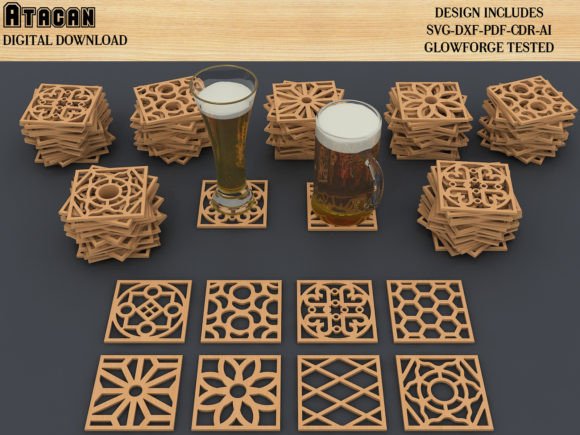
Wood Metal Coasters Laser Cut Patterns
If you're cutting custom coasters on a Glowforge Pro—or any laser cutter or paper craft machine—you need precision, consistency, and flexibility. That’s exactly what Wood Metal Coasters Laser Cut Patterns deliver: ready-to-use, field-tested vector files engineered for real-world fabrication, not just theoretical compatibility.
These aren’t generic clipart or scaled-down illustrations. They’re production-grade patterns built from the ground up for material integrity, kerf compensation, and clean edge definition—whether you’re working with 1/8" birch plywood, anodized aluminum sheet, or even thick cardstock for mockups. Each design has been physically cut and verified on a Glowforge Pro, meaning no surprises at the machine: no overlapping paths, no stray nodes, no hidden layers that stall your job mid-run.
Why These Patterns Stand Out in Practice
Most coaster templates online fall into two categories: overly simplified (lacking structural detail) or over-engineered (with unnecessary complexity that slows down nesting or confuses entry-level software). Wood Metal Coasters Laser Cut Patterns avoid both traps. They include subtle but critical features—like 0.005" relief cuts for easy tab removal, optimized corner radii to prevent charring on wood, and mirrored alignment marks for multi-layer metal+wood composites.
The file suite covers all major vector formats: DXF (for CorelDRAW, LightBurn, RDWorks), SVG (Cricut Design Space, Silhouette Studio, Inkscape), AI (Adobe Illustrator), CDR (CorelDRAW), and PDF (universal preview + basic editing). A high-res JPG is included—not as a substitute, but as a quick visual reference when sorting folders or sharing previews with clients before cutting begins.
Real Applications Across Real Roles
A freelance product designer used these patterns to prototype a line of branded oak-and-brass coasters for a boutique coffee roaster—cutting 48 units in under 90 minutes across three Glowforge passes. No rework. No misaligned engraving zones. Just consistent, tactile pieces that matched the brand’s warm-but-precise aesthetic.
In a high school STEM lab, a teacher imported the SVGs into Silhouette Studio and adapted them for cardboard and acrylic. Students then laser-cut, engraved quotes, and assembled kits—learning about tolerances, material behavior, and iterative design—all within a single 75-minute class block.
At a small-batch gift shop, the owner runs the DXF files through LightBurn on a 60W diode cutter, swapping between 3mm bamboo and 0.8mm stainless steel depending on season and customer request. Because the patterns are dimensionally stable across materials, she doesn’t need separate files for each substrate—just adjusted power/speed settings.
What Works—and What Doesn’t—With These Files
These patterns excel where geometry meets function: circular, hexagonal, and square coasters ranging from 3.5" to 4.25" in diameter, with optional center recesses (0.125" deep), beveled edges (15° chamfer), and integrated branding zones sized for 8–12 pt engraving. They’re built to nest efficiently—most designs tile with ≤1.5mm spacing—reducing waste on standard 12"x20" sheets.
They’re not meant for ultra-thin foil or flexible vinyl—those require different kerf and hold-down strategies. And while they scale well, we don’t recommend enlarging beyond 5" without verifying grain direction (for wood) or thermal warping (for thin metal). For best results, use them at native size or scale uniformly—no stretching or skewing.
Compatibility Beyond the Obvious
You’ll see “Glowforge compatible” everywhere—but true cross-platform utility goes deeper. These files open cleanly in Cricut Design Space *without* auto-tracing prompts or missing strokes. They import into Silhouette Studio v5+ with grouped layers intact. In LightBurn, all cut lines default to “cut” mode with correct power presets embedded as layer names (e.g., “Wood_120W”, “Aluminum_350W”). Even Brother ScanNCut users report success after converting SVG to FCM via the official converter—no path reconstruction needed.
That level of interoperability comes from strict adherence to vector fundamentals: all shapes are closed paths, text is outlined, strokes are converted to fills, and RGB/CMYK color assignments are removed (since lasers read vector data—not color). There are no embedded raster images, no linked assets, and no font dependencies.
Getting Started Without Guesswork
Start by opening the SVG in your preferred software and checking layer visibility. Most machines treat layers as operation queues—so “Engrave_Brand” sits above “Cut_Outline”, ensuring the logo etches *before* the coaster separates from the sheet. If you’re using a diode laser or older CO₂ system, verify that the cut lines are set to 0.001" stroke width (not hairline) for reliable detection.
For metal, always test on scrap first—even with pre-verified settings. Anodized aluminum behaves differently than bare stainless; brushed finishes scatter more light than polished ones. With wood, factor in seasonal humidity: birch cut in winter may need 2–3% less power than the same file cut in summer.
And if you’re batch-producing for resale? Use the AI or CDR files to add serial numbers or date stamps directly in Illustrator or Corel—then export fresh SVGs per batch. No need to re-import or reposition. The base pattern stays untouched, preserving repeatability across hundreds of units.
More Than Just Coasters—A Foundation for Iteration
Once you’ve cut your first set, you’ll notice how easily these patterns adapt. Flip the orientation to create nested sets (four coasters fitting precisely inside one larger ring). Duplicate and offset paths to build stacking stands or display trays. Add your own engraving motifs inside the recessed zone—monograms, QR codes linking to care instructions, or subtle texture fills that catch light differently across materials.
That adaptability is why educators use them in design thinking workshops, makers integrate them into subscription box kits, and small studios treat them as foundational assets—not one-off downloads. They’re designed to be modified, extended, and embedded—not just executed.
Whether you’re launching a side hustle, equipping a makerspace, or prototyping for a client pitch, Wood Metal Coasters Laser Cut Patterns remove friction from the earliest stage of making. No decoding cryptic file structures. No hunting for missing fonts or broken links. Just clean, tested, production-ready vectors—ready to cut, engrave, and ship.