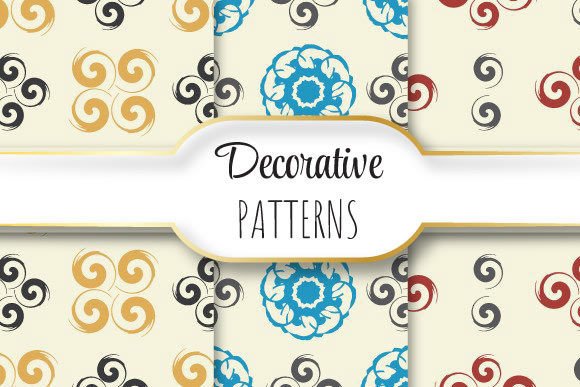
Understanding Decorative Patterns and Seamlessly Repeating Vector Patterns
Decorative patterns are everywhere—from the wallpaper in your living room and the fabric of your favorite shirt to the background of a mobile app or the packaging of a premium skincare product. But not all decorative patterns are created equal. When designers, marketers, and print professionals talk about seamlessly repeating vector patterns, they’re referring to a specific, highly functional category of digital design assets—ones engineered for infinite, invisible repetition without visual breaks or misalignments. These aren’t just pretty graphics; they’re precision-crafted tools built for scalability, versatility, and professional-grade output.
What Exactly Is a Seamless Repeating Vector Pattern?
A seamless repeating vector pattern is a design that tiles perfectly in all directions—horizontally and vertically—so that when repeated across a surface, no seam, gap, or mismatch is visible. The “vector” part means it’s built using mathematical paths (not pixels), so it can scale infinitely without losing clarity. Unlike raster images (like JPEGs or PNGs), which become blurry when enlarged, vector patterns retain razor-sharp edges at any size—whether printed on a business card or a 20-foot trade show banner.
Seamlessness isn’t accidental—it’s intentional engineering. Designers use precise alignment, mirrored or offset elements, and careful edge-matching techniques to ensure the right edge of the pattern connects flawlessly with its left edge, and the top aligns perfectly with the bottom. This makes them ideal for applications where continuity matters: textile printing, web backgrounds, packaging wraps, branding collateral, and even UI/UX design systems.
Why the 12 × 12 Inch, 3600 × 3600 Pixel, 300 DPI Specification Matters
The dimensions you’ll often see—12 × 12 inches at 3600 × 3600 pixels and 300 DPI—are industry standards for high-resolution print-ready files. Here's why:
- 12 × 12 inches provides a generous, manageable tile size—large enough to contain rich detail but compact enough to repeat efficiently across large surfaces.
- 3600 × 3600 pixels ensures crisp rendering at 300 dots per inch—the gold standard for professional offset and digital printing. At this resolution, fine lines, gradients, and subtle textures remain clean and legible.
- 300 DPI guarantees sharpness for physical outputs like brochures, stationery, apparel, and signage—where lower resolutions would appear grainy or pixelated.
This specification bridges the gap between digital flexibility and print fidelity—making each pattern equally useful for screen-based mockups and real-world production.
EPS 10: The Professional Choice for Vector Patterns
The EPS (Encapsulated PostScript) file format, specifically version 10, remains a trusted standard among designers and printers. Why? Because EPS files embed both vector paths and optional raster previews, support transparency and layers, and maintain full editability in Adobe Illustrator and other vector editors. Unlike newer formats like SVG (which excels online but lacks advanced print features), EPS 10 delivers reliable color accuracy, CMYK support, and compatibility with legacy prepress workflows.
When a zip package includes three EPS files, it typically offers variations—such as light/dark versions, alternate colorways, or scaled complexity levels—to give users creative flexibility without needing to modify the original artwork. Each EPS file is fully editable: colors can be adjusted, elements rearranged, and components isolated—all while preserving the seamless tiling logic.
Why JPEGs Are Included Too
Alongside the three EPS files, the same zip contains three JPEG files. These serve an important practical purpose: quick previewing, web use, and compatibility with platforms that don’t support EPS (e.g., basic email clients, social media schedulers, or CMS upload forms). While JPEGs are raster-based and not scalable, these are generated at the same 3600 × 3600 pixel resolution—ensuring faithful representation of the pattern’s appearance, color balance, and tiling behavior.
Think of the JPEGs as “reference snapshots”—ideal for client presentations, mood boards, or digital prototyping—while the EPS files remain the source of truth for production.
Real-World Applications Across Industries
Seamlessly repeating vector patterns aren’t niche design artifacts—they power real business outcomes. Consider these everyday examples:
- Fashion & Textiles: A boutique brand uses a custom botanical pattern to print scarves and tote bags. Because the pattern is seamless and vector-based, it scales effortlessly from a 1-inch label to a 5-yard fabric bolt—no redesign needed.
- Packaging Design: A craft beverage company wraps its cans and six-pack carriers with a cohesive geometric motif. The seamless tile ensures consistent alignment across curved and flat surfaces—even when shrink-wrapped or die-cut.
- Digital Branding: An edtech startup applies a subtle, low-contrast pattern as a background element across its website, slide decks, and app interface. The vector origin allows crisp rendering on retina displays and responsive layouts alike.
- Interior Design: A residential designer selects a marble-vein vector pattern for wall murals and custom upholstery. Its scalability means one file serves both a powder-room accent wall and a full-length sofa cover.
Common Misconceptions—Clarified
It’s easy to assume that any tiled image qualifies as “seamless”—but that’s not quite right. Many free online patterns have visible seams, inconsistent spacing, or raster-only builds that degrade at larger sizes. Others claim “vector” status but are merely raster images embedded inside an EPS wrapper—offering no real scalability.
True seamless vector patterns must pass three tests:
- Visual continuity: No visible line, jump, or color shift at tile boundaries—even when zoomed in at 400%.
- Mathematical precision: Built using vector anchors, Bézier curves, and aligned bounding boxes—not traced or auto-tiled.
- Production-readiness: Fully compatible with commercial printing workflows—including spot color separation, overprint settings, and bleed-safe construction.
If a pattern fails any of these, it may look fine on screen—but won’t hold up under professional scrutiny.
How to Use These Files Effectively
Whether you're a graphic designer, small-business owner, educator, or DIY enthusiast, here’s how to get the most from your seamless vector pattern set:
- For designers: Open EPS files in Illustrator, then use Object > Pattern > Make to convert into a swatch—enabling instant application to shapes, text outlines, or complex paths.
- For marketers: Use the JPEGs to build branded email headers, social media banners, or PowerPoint templates—ensuring visual consistency without technical overhead.
- For educators: Introduce students to vector fundamentals by deconstructing the pattern layers—highlighting anchor points, clipping masks, and repeat logic as teachable moments.
- For print vendors: Share EPS files directly with your printer—they’ll appreciate the native CMYK support, embedded fonts (if applicable), and absence of linked image dependencies.
And remember: because these patterns are built to tile infinitely, you’re never limited to 12 × 12 inches. In Illustrator or Photoshop, simply define a larger artboard and fill it with the pattern swatch—or use the “Pattern Options” panel to adjust spacing, size, and overlap for custom effects.
Final Thoughts: More Than Just Decoration
At first glance, decorative patterns may seem like purely aesthetic choices—background flourishes with little functional weight. But seamlessly repeating vector patterns represent something deeper: intentionality, craftsmanship, and cross-platform utility. They reflect an understanding that great design isn’t just seen—it’s experienced across touchpoints, scaled across mediums, and reproduced with reliability.
Whether you’re launching a product, teaching design principles, refreshing a brand identity, or simply seeking inspiration, investing in professionally built, technically sound vector patterns pays dividends. They save time, reduce revision cycles, future-proof your assets, and elevate perceived quality—without requiring advanced software skills to deploy.
So next time you admire a beautifully wrapped gift box, scroll through a polished website, or run your fingers over a textured notebook cover—look closer. Chances are, a thoughtfully engineered seamless vector pattern is working quietly behind the scenes, making continuity feel effortless, and design feel intentional.