Plaid Seamless Patterns Set
If you’ve ever spent hours trying to tile a plaid background only to spot visible seams, misaligned repeats, or blurry edges—especially at print size—you’re not alone. The Plaid Seamless Patterns Set solves that exact problem: it’s a thoughtfully crafted digital paper pack designed for real-world use—not just pixel-perfect previews. Whether you're designing wedding invitations in Canva, building Shopify product mockups in Photoshop, printing planner covers on premium cardstock, or even prototyping fabric swatches, this set delivers consistency, clarity, and true seamlessness—no manual editing required.
Why “Seamless” Isn’t Just Marketing Speak—It’s Measurable
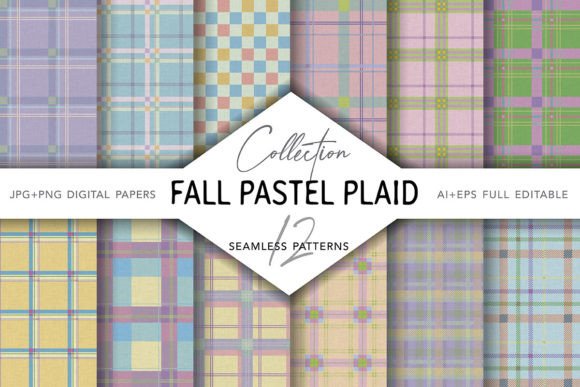
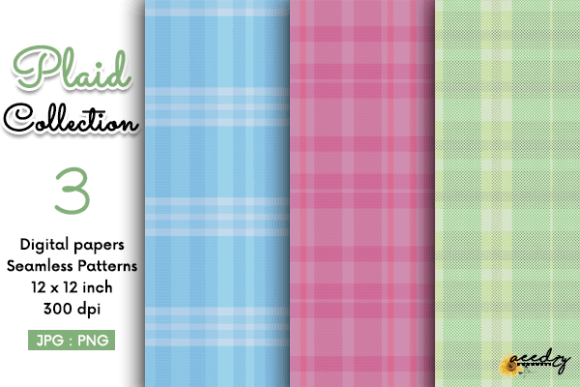
Many pattern packs claim to be seamless, but few deliver across all common use cases. A truly seamless pattern must repeat flawlessly in any direction—horizontally, vertically, and diagonally—without ghost lines, color shifts, or subtle texture breaks. The Plaid Seamless Patterns Set achieves this through precise alignment at the canvas edges and consistent 300 DPI resolution across all six files (3 JPG + 3 PNG). Each file is exactly 12 × 12 inches (3,600 × 3,600 pixels), meaning it scales cleanly for large-format prints like wallpaper or gift wrap—and holds crisp detail even when zoomed in for web UI backgrounds or journal cover close-ups.
Mistake #1: Assuming All Plaid Patterns Scale Equally Well
Not all plaids behave the same under scaling. Thin-line plaids can vanish or pixelate below 50% size; bold, high-contrast ones may overwhelm small cards or blog headers. The Plaid Seamless Patterns Set includes three distinct weights—subtle micro-plaid, balanced mid-scale, and confident wide-stripe—so you match pattern density to your project’s context. For example: use the micro-plaid for delicate wedding stationery or email newsletter headers; reserve the wide-stripe for fabric prototypes or shop banner backdrops where visual impact matters more than fine detail.
Mistake #2: Overlooking File Format Nuances
JPGs are great for fast web previews and lightweight email attachments—but they don’t support transparency. PNGs do. If you’re layering a plaid over photos (e.g., photo album overlays) or placing text with drop shadows directly on the pattern (like printable quote cards), PNGs preserve clean edges and alpha channels. Download both—and label them clearly in your asset library so you don’t reach for a JPG when transparency is needed.
Mistake #3: Skipping the “Test Tile” Step Before Final Output
Even with seamless design, your editor software can introduce artifacts. Some programs apply automatic sharpening or compression during export; others default to RGB instead of CMYK for print jobs. Before sending to press or uploading to Etsy, test-tile your chosen pattern at actual size in your final layout. In Adobe Illustrator, use Object > Pattern > Make; in Canva, duplicate and nudge layers to check edge continuity. If you see a faint line or tone shift where tiles meet—go back and verify your document’s color profile and export settings.
Mistake #4: Ignoring Real-World Print Behavior
A 300 DPI file looks sharp on screen—but if your printer applies heavy halftoning or uses low-gloss paper, fine plaid lines can blur or bleed. The Plaid Seamless Patterns Set avoids this by using intentional line weight and spacing calibrated for physical output. Still, always run a single-page proof on your target paper stock first. For matte invitations, consider reducing contrast slightly in your editor; for glossy wrapping paper, lean into the full vibrancy—the patterns were built to hold up either way.
What to Check Before You Use or Buy
- Resolution & dimensions: Confirm it’s truly 3,600 × 3,600 px at 300 DPI—not upscaled from a smaller base. Downsampling degrades quality; upsampling creates softness. This set starts at print-ready size.
- True seamlessness: Open one file in your editor, duplicate the layer, and offset it by exactly half the canvas width (1,800 px). Zoom in tightly at the meeting point—if you see no discontinuity in line alignment or tone, it’s genuinely seamless.
- Format versatility: Does it include both JPG and PNG? PNGs let you overlay text or logos without white boxes; JPGs keep file sizes lean for web use. Having both means fewer workarounds later.
- Licensing clarity: This set permits commercial use—including selling printed planners, physical wedding suites, or digital downloads—without requiring attribution. Always double-check the license included in the ZIP, especially if reselling as part of a larger bundle.
Better Choices Start With Intentional Use
You don’t need ten plaid packs to get great results—you need one that works reliably across tools and outputs. The Plaid Seamless Patterns Set was built for practicality: no hidden layers, no watermarks, no extra plugins or fonts required. It opens instantly in Affinity Designer, Procreate, Figma, Cricut Design Space, and even Google Slides (via image upload). That means less time troubleshooting compatibility and more time focusing on your message—whether it’s a heartfelt invitation, a polished brand mood board, or a cohesive Etsy shop aesthetic.
Think of it like choosing quality thread over cheap yarn: both hold fabric together, but only one stays strong after repeated handling, washing, and display. Similarly, a well-built seamless pattern holds up across revisions, client feedback rounds, and multiple output formats—saving you time, reducing rework, and preserving your creative credibility.
Real Projects, Real Flexibility
One educator used the mid-scale plaid to design printable classroom behavior charts—printed weekly on copy paper, then laminated. The crisp lines stayed legible after months of dry-erase marking. A small-batch candle maker applied the wide-stripe version to kraft tags, then ran them through a home inkjet—no bleeding, no smudging, just rich texture that customers photographed and shared. A freelance web designer layered the micro-plaid subtly behind a blog’s sidebar menu, adjusting opacity to 8% for visual interest without sacrificing readability.
None of these successes relied on advanced skills—just knowing what the files could do, testing early, and matching pattern weight to purpose. That’s the quiet advantage of a deliberately made resource: it expands what’s possible for beginners and streamlines workflow for pros—without demanding extra learning curves.
So before you search for “free plaid background” and risk inconsistent repeats or murky downloads, consider what consistency actually saves you: time, confidence, client trust, and the quiet satisfaction of hitting “print” or “publish” knowing it’ll look exactly as intended—every single time.