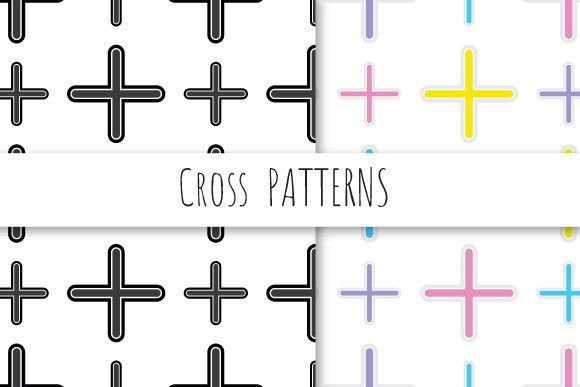
Cross Patterns in Professional Design: Precision, Scalability, and Seamless Repetition
Across industries—from textile manufacturing and architectural visualization to digital branding and print publishing—designers rely on vector-based pattern assets that combine mathematical rigor with visual harmony. Among the most versatile and widely adopted is the Cross Patterns family: a set of rigorously constructed, infinitely tileable motifs built around intersecting linear elements. Unlike raster-based repeats or hand-drawn textures, these patterns are engineered for fidelity at any scale, making them indispensable for high-resolution output workflows.
Why Vector Precision Matters at 300 DPI and Beyond
Each file in this collection measures exactly 12 x 12 inches, rendered at 3600 x 3600 pixels—a resolution calibrated for professional-grade printing at 300 DPI. This isn’t arbitrary. At 300 DPI, every inch contains 300 distinct dots of ink or toner; stretching a lower-resolution image risks visible pixelation, blurring, or moiré artifacts—especially in tight geometric arrangements like cross motifs. Vector formats eliminate that risk entirely. The EPS 10 files preserve path data, anchor points, and Bézier curves without approximation, ensuring crisp edges whether scaled to a business card or a 20-foot trade show backdrop.
Consider a packaging designer applying a Cross Patterns motif to a luxury soap box. If the design were delivered as a JPEG alone, resizing for foil-stamping plates (which often require 2400+ DPI line work) would demand re-rasterization—introducing interpolation errors and subtle misalignments in the cross intersections. With EPS 10, the same vector paths feed directly into RIP (Raster Image Processor) software, maintaining sub-pixel accuracy across all output devices.
The Architecture of Seamless Repetition
“Seamlessly repeating vector patterns” aren’t just visually continuous—they’re mathematically closed. Each tile’s right edge matches its left, its top aligns perfectly with its bottom, and diagonal continuity is preserved where applicable. In Cross Patterns, this means every horizontal stroke terminates precisely where the next tile’s stroke begins; every vertical segment aligns across tile boundaries without gaps, overlaps, or micro-shifts.
This seamlessness isn’t achieved through masking or blending—it’s encoded in the coordinate system. The pattern’s bounding box is defined by exact multiples of stroke width, spacing intervals, and intersection angles. For example, a 45-degree cross variant may use a base grid unit of 0.125 inches, ensuring that rotational symmetry and translational tiling coexist without cumulative drift over large surfaces. That level of control enables applications like wallcoverings, where a single 12×12-inch tile can replicate across hundreds of square feet without visible seams or rhythm breaks.
Two EPS Files, Two Distinct Structural Logics
The ZIP package includes two EPS files, each representing a unique structural interpretation of the Cross Patterns concept:
- CrossGrid_EPS10_Base: A modular lattice built from orthogonal strokes—horizontal and vertical lines intersecting at perfect 90-degree angles. Stroke weights are uniform (0.75 pt), spacing is strictly periodic (0.25 inches between centers), and anchor points are aligned to integer coordinates within the 3600×3600-pixel canvas. Ideal for technical diagrams, engineering overlays, or minimalist textile weaves.
- CrossDynamics_EPS10_Variant: Introduces controlled variation—slight angular modulation (±2.3°), alternating stroke weights (0.5 pt / 1.0 pt), and staggered intersection offsets. Though visually richer, it retains full seamlessness because modulation follows a deterministic algorithm tied to tile position. Used in branding systems requiring warmth without sacrificing scalability—e.g., a university’s environmental graphics program unifying signage, apparel, and digital interfaces.
Both files adhere to Adobe Illustrator’s EPS 10 specification, supporting transparency, spot color definitions, and embedded ICC profiles—critical when matching Pantone inks or managing CMYK-to-RGB conversions across media.
Practical Integration Across Workflows
Designers don’t use EPS files in isolation. Their value emerges in context—how they interact with other assets, tools, and constraints. Here’s how Cross Patterns integrate across common scenarios:
Print Production: From Mockup to Press
A print shop receives a brochure layout with a Cross Patterns background applied as an EPS. Because the file contains no embedded raster data, preflight checks confirm zero font dependencies, no missing links, and consistent path outlines. When generating PDF/X-4 output, the pattern remains vector-native—no flattening required. That preserves editability for last-minute client revisions (e.g., adjusting stroke color to match a new brand palette) without re-exporting or quality loss.
Digital Publishing: Responsive Adaptation Without Rework
Web developers converting print assets for interactive use often face resolution traps. A JPEG version of the same pattern—while convenient for HTML backgrounds—loses fidelity on Retina displays or when zoomed. By contrast, modern CSS supports SVG embedding, and EPS files can be converted losslessly to SVG using Illustrator’s “Export As > SVG” function with “Responsive” and “Minify” options enabled. The resulting code retains precise stroke geometry and scales fluidly across viewport sizes—proving that Cross Patterns’ vector foundation serves both physical and screen-based environments equally well.
Educational Use: Teaching Pattern Theory Through Real Assets
In design pedagogy, abstract discussions of tessellation or symmetry gain clarity when students manipulate actual production-ready files. An educator might assign a project where learners modify the CrossGrid_EPS10_Base file—changing spacing values, introducing dash patterns, or exporting variants at different DPI settings—to observe how parameter shifts affect tiling behavior. Because the source is editable vector—not flattened pixels—students explore cause-and-effect relationships in real time, reinforcing concepts like periodicity, translational symmetry, and resolution independence.
Complementary JPEG Files: Purpose-Built, Not Redundant
The ZIP also includes two JPEG files, each serving a specific, non-overlapping role:
- CrossGrid_JPEG_Proof.jpg: A flattened, sRGB-encoded preview at full 3600×3600 resolution. Used for quick visual verification—checking color fidelity, contrast balance, and overall motif density before opening vector editors. Its embedded color profile ensures accurate soft-proofing on calibrated monitors.
- CrossDynamics_JPEG_Thumbnail.jpg: A 600×600-pixel, sharply optimized thumbnail with embedded EXIF metadata identifying the parent EPS file, creation date, and author contact. Designed for DAM (Digital Asset Management) systems, content libraries, or internal style guides where fast scanning and attribution matter more than editing capability.
Neither JPEG replaces the EPS—their inclusion reflects a pragmatic understanding of workflow fragmentation. Not every stakeholder needs vector editability. A marketing manager reviewing layout comps benefits from instant JPEG visibility; a production artist requires the EPS’s precision. Offering both respects real-world collaboration models.
User Considerations: When Cross Patterns Excel—and When They Don’t
While powerful, Cross Patterns aren’t universally optimal. Their strengths emerge most clearly under certain conditions:
- Best for: Applications demanding infinite scalability, strict geometric consistency, multi-output compatibility (print + web + embroidery), and long-term asset reuse. Common in corporate identity systems, technical documentation, architectural surface design, and academic publishing.
- Less suited for: Organic, hand-rendered aesthetics (e.g., watercolor washes or charcoal sketches), irregular natural textures (wood grain, stone), or patterns relying on photorealistic depth cues. Cross Patterns prioritize clarity and repeatability—not illusionistic realism.
- Key considerations: Always verify color mode alignment (CMYK EPS for offset printing, RGB EPS for digital-only use); test tiling behavior in your target application (some older RIPs handle complex EPS clipping paths unpredictably); and confirm that stroke widths remain legible at final output size—0.25 pt may vanish on newsprint but shine on fine-art paper.
Real-World Observations: What Practitioners Notice First
Users consistently report three immediate observations after integrating Cross Patterns into active projects:
- Faster iteration cycles: Adjusting a single stroke weight or spacing value in the EPS propagates instantly across all repeated instances—no manual copy-paste or script dependency.
- Reduced vendor friction: Print providers accept EPS files without requesting alternate formats, reducing back-and-forth and timeline risk.
- Consistent perception across contexts: A CrossGrid motif appears equally authoritative on a laser-engraved metal plaque and a responsive website banner—reinforcing brand cohesion without visual dissonance.
That consistency stems not from stylistic uniformity, but from underlying structural integrity. Each Cross Patterns file embodies a set of constraints—mathematical, technical, and perceptual—that guide rather than restrict creative decisions.
Looking Ahead: Trends Reinforcing Cross Patterns’ Relevance
Three emerging developments reinforce why Cross Patterns remain strategically valuable:
- AI-assisted design tooling: Generative plugins increasingly accept vector primitives as input. A well-structured Cross Patterns EPS can serve as a training seed for AI systems learning rhythmic composition—feeding clean, rule-based geometry instead of noisy raster samples.
- Sustainability in digital production: Vector files generate smaller PDFs, reduce cloud storage overhead, and minimize rendering load on low-power devices—contributing to measurable energy savings across distributed publishing ecosystems.
- Accessibility-aware patterning: High-contrast, predictable cross structures support visual scanning for users with low vision. When combined with semantic SVG markup (e.g.,
Geometric Grid Pattern
In essence, Cross Patterns represent more than decorative motifs—they’re interoperable design primitives. Their 12×12-inch, 300-DPI, EPS 10 specification isn’t a limitation; it’s a commitment to precision, longevity, and cross-platform reliability. Whether you’re specifying fabric for a museum installation, developing UI components for a government portal, or teaching foundational design theory, these assets provide a shared language—one rooted in measurement, repetition, and seamless execution.