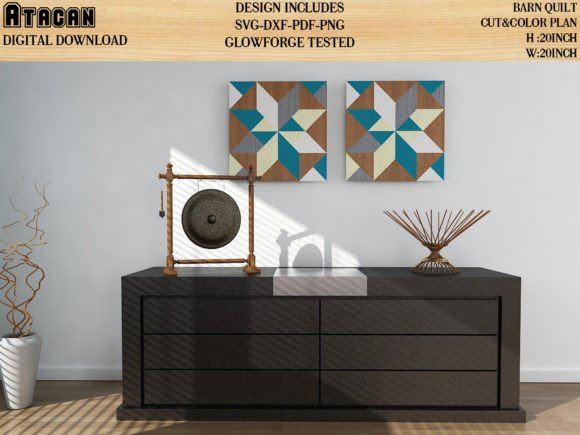
Barn Quilt Block Farmhouse Patterns
There’s a quiet resurgence happening in maker spaces, home studios, and small creative businesses — one rooted in heritage, visual storytelling, and hands-on craftsmanship. Barn Quilt Block Farmhouse Patterns sit at the intersection of this movement: honoring rural American tradition while meeting modern digital fabrication needs with precision, flexibility, and timeless appeal. These aren’t just decorative motifs — they’re scalable, production-ready vector designs built for real-world use across laser cutters, paper craft machines, and hybrid workflows.
More Than Nostalgia — A Practical Design Language
Barn quilts originated as painted wooden panels mounted on barns to celebrate family history, community identity, or regional pride. Today, that same symbolic language translates powerfully into physical and digital making. Barn Quilt Block Farmhouse Patterns distill that visual vocabulary into clean, geometric blocks — stars, churn dashes, log cabins, nine-patches, and more — optimized for accuracy and repeatability. Each pattern is mathematically balanced, with consistent line weights, closed paths, and zero overlapping vectors — critical for reliable cutting on any machine.
What makes these files distinctive isn’t just their aesthetic; it’s their technical readiness. Designed originally for the Glowforge Pro (and rigorously tested on it), they maintain fidelity across platforms — whether you’re running a Cricut Maker 3, Silhouette Cameo 4, Brother ScanNCut SDX125, or industrial-grade CO₂ laser. That cross-platform reliability reflects a broader shift: creators no longer want “one machine, one file” solutions. They need interoperable assets — and Barn Quilt Block Farmhouse Patterns deliver that without compromise.
Why Vector Compatibility Matters Now More Than Ever
Creative professionals today juggle multiple tools, clients, and output formats. A graphic designer might prep a sign for local farmers’ market branding using Illustrator, then send the same file to a client with a desktop Cricut for DIY wall art. An educator building tactile learning kits may print scaled versions on cardstock via PDF, then cut durable acrylic versions later using DXF. That fluidity only works when files are truly universal — not just “exported” but engineered for consistency.
The inclusion of SVG, DXF, PDF, AI, and CDR formats isn’t about checking boxes. It’s about supporting actual workflows: SVG for web-based design tools and quick edits; DXF for CNC and industrial lasers; PDF for print-and-cut setups; AI for Adobe ecosystem users; CDR for CorelDRAW loyalists. Even the JPG reference files serve a purpose — helping users preview proportions, color blocking, and layout before committing material or machine time.
Fitting Into Evolving Creative Habits
People aren’t just buying patterns — they’re investing in systems. The rise of hybrid crafting (digital + analog), micro-businesses built around custom signage or home décor, and the growing demand for locally resonant design all point toward Barn Quilt Block Farmhouse Patterns as functional infrastructure. Consider a small-town café owner wanting rustic-chic coasters: instead of sourcing generic clipart or hiring a designer for $200+, they download a set, adjust spacing in Inkscape, and cut 50 pieces in under an hour. Or a homeschool parent creating fraction tiles using quilt block geometry — reinforcing math concepts through tangible, beautiful objects.
This mirrors larger behavioral trends: shorter project cycles, preference for modular components, and emphasis on scalability. A single Barn Quilt Block Farmhouse Pattern can become a coaster, a tile inset, a quilt square template, a vinyl decal, or even a laser-etched wood slice for wedding favors. Its value multiplies with reuse — not just across projects, but across skill levels. Beginners appreciate the clean lines and intuitive symmetry; advanced users leverage layers and grouping to build complex mosaics or nested layouts.
Real-World Use Across Machines and Materials
Testing confirms performance across diverse hardware. On a Glowforge Pro, patterns cut cleanly in 1/8″ birch plywood at 100% power, 100% speed, with no charring or hesitation. On a Cricut Maker 3 with the Knife Blade, they score and cut heavy cardstock (110 lb) with crisp edges. With a Silhouette Cameo 4 and ratchet blade, they handle chipboard up to 2mm thick. Even Sizzix Big Shot users report success adapting the PDF layouts for manual die-cutting templates.
Material versatility follows naturally. Wood, acrylic, leather, cork, mat board, magnetic sheet, and even thin metals (with appropriate machine specs) respond well to the precise pathing. For paper craft machines like Gemini or Brother ScanNCut, the absence of hairline gaps or stray anchor points prevents misfeeds and ensures registration marks align correctly. That attention to file hygiene — often overlooked in free or low-cost pattern libraries — is what separates usable from frustrating.
Supporting Business and Teaching Needs
For entrepreneurs, these patterns reduce overhead. No need to redraw classic motifs from scratch or license expensive clipart with restrictive terms. You own the files outright, and commercial use is included — meaning you can sell finished items, offer custom engraving services, or bundle them into digital product kits. Educators benefit similarly: downloadable, classroom-safe files that align with STEAM goals — symmetry, geometry, scale, and cultural studies — all embedded in a single asset.
One small business owner in Ohio uses Barn Quilt Block Farmhouse Patterns to create rotating seasonal displays for her gift shop: spring florals layered over star blocks, fall harvest colors in churn-dash arrangements. She updates visuals monthly without redesigning — just swapping color palettes and nesting new elements. Another user, a middle school art teacher, prints the PDFs at varying scales so students can trace, measure angles, and discuss proportion — turning pattern work into active learning.
Thoughtful Design, Not Just Trend-Chasing
Unlike fleeting design fads, Barn Quilt Block Farmhouse Patterns reflect enduring values: clarity, repetition with variation, and respect for material integrity. They don’t rely on photorealism or excessive detail — which often fail in cutting or scaling — but on strong underlying structure. That makes them resilient to changes in software updates, machine generations, or even shifts in consumer taste. A log cabin block reads clearly at 2 inches or 24 inches. A nine-patch maintains balance whether cut from walnut veneer or recycled kraft paper.
That durability matters. As more people adopt hybrid workflows — blending digital design with hand-finishing, or mixing machine-cut parts with traditional stitching — having foundational patterns that behave predictably becomes essential. It’s not about chasing novelty; it’s about building a reliable toolkit that grows with your practice.
Getting Started Is Intentional, Not Complicated
You don’t need a Glowforge to begin — though if you have one, the files are tuned to its calibration standards. Start by opening the SVG in your preferred vector editor, adjusting stroke settings to match your machine’s requirements (typically 0.001 pt for cut lines), then exporting to the native format your device expects. For paper craft machines, import the PDF directly — many auto-detect registration marks. If you’re new to vector editing, the included JPGs provide accurate visual references for sizing and alignment.
Experimentation is encouraged. Try layering two blocks with slight offsets for shadow effects. Use the DXF version to nest multiple units within a single sheet for material efficiency. Combine with text elements to create personalized signs — “The Miller Farm • Est. 1947” beneath a double-star block, for instance. The patterns support intention, not limitation.
Ultimately, Barn Quilt Block Farmhouse Patterns represent something quietly powerful: the merging of heritage craft logic with contemporary digital fluency. They meet makers where they are — whether launching a side hustle, teaching visual literacy, or simply bringing warmth and story into everyday objects — without asking them to choose between authenticity and efficiency.