Vintage Garden Digital Papers Patterns
If you’ve ever scrolled through design marketplaces searching for that perfect botanical backdrop—soft watercolor leaves, delicate florals, faded sepia stems, or hand-painted roses with just the right amount of texture—you know how rare it is to find digital papers that feel both timeless and versatile. Vintage Garden Digital Papers Patterns isn’t just another set of clipart or stock backgrounds. It’s a thoughtfully curated bundle of eight seamless, hand-painted digital papers designed to bring warmth, authenticity, and quiet elegance to real creative work—not just mood boards.
What Makes These Papers Feel Like “Real” Vintage?
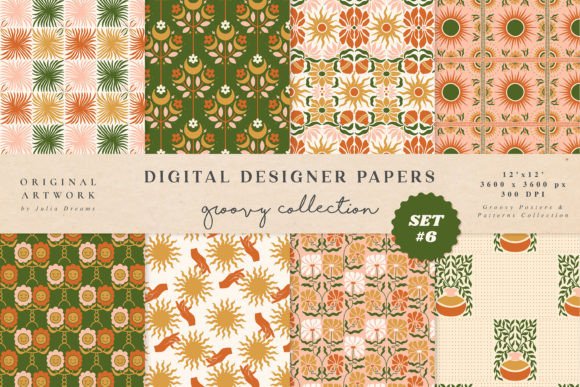
It’s not just the subject matter—it’s the process. Each pattern in the Groovy Posters and Patterns Bundle 6 was created using actual watercolor, ink, and gouache, then digitally refined to preserve subtle paper grain, pigment bleed, and gentle imperfections. That means no sterile vector repetition or AI-generated uniformity. When you zoom in on a 3600 x 3600 px file, you’ll see the faint halo around a petal, the soft edge where green bleeds into cream, the slight variation in stroke weight across a vine. That authenticity translates directly into how your final project feels: grounded, intentional, human-made.
Where These Patterns Shine (and Why They’re Worth More Than Just “Pretty”)
Designers, small business owners, and DIY creators don’t reach for vintage garden patterns because they’re nostalgic—they reach for them because they solve problems:
- Wedding stationery that doesn’t look like every other Etsy listing. A couple wants their invites to whisper “garden ceremony at grandma’s cottage,” not “Pinterest trend.” Using one of these papers as a subtle background layer under elegant serif type—or as a textured border on RSVP cards—adds depth without competing. Try the muted sage-and-cream pattern behind a minimalist monogram: it reads as refined, not fussy.
- Small-batch product branding that builds trust. Think herbal tea labels, artisan soap packaging, or apothecary-style candle tags. Consumers today respond to cues of care and craft—and hand-painted botanicals signal that someone paid attention to detail. One maker used the dusty rose & thyme pattern as a base for her seasonal label series; customers regularly comment on how “calming” and “thoughtful” the packaging feels.
- Social media content that stops the scroll—without shouting. On Instagram or Pinterest, overly saturated or busy graphics often get skipped. But a softly textured vintage garden paper as a background for a quote graphic (“Grow through what you go through”) or a seasonal tip (“Five herbs to plant in early spring”) creates visual breathing room—and emotional resonance. It works especially well for wellness coaches, garden educators, and mindful lifestyle bloggers.
- Print-on-demand products with personality. Unlike generic floral repeats, these papers scale beautifully from greeting cards to 24x36" wall art prints. Because they’re offered in both raster (.jpg/.png) and vector (.ai/.eps) formats, you can resize confidently—for fabric printing (think napkins or tote bags), wallpaper mockups, or even laser-cut planner inserts. One customer printed the lavender-and-linen pattern on linen-textured cardstock for wedding menus—and guests kept them as keepsakes.
Who Uses This Bundle—and How Their Needs Differ
A freelance logo designer might use the vector files to build a custom brand pattern for a new organic skincare line—layering the floral motif subtly into business cards or email headers. Meanwhile, a homeschool parent creating themed unit studies might print the same pattern on sticker paper to decorate nature journals or flashcards. A wedding planner could license the files to include in client presentation decks—showing how invitations *could* look when paired with specific fonts and foil accents.
Even non-designers benefit. If you’re building a blog about sustainable gardening, you can use the .png files as featured image backdrops (just add text overlay in Canva). If you sell digital planners on Gumroad, drop one of these papers into your cover design—it instantly signals “thoughtful, nature-inspired, calm”—which aligns with how your audience wants to feel while planning their week.
Practical Things to Keep in Mind Before You Use Them
These aren’t plug-and-play filters. To get the most out of Vintage Garden Digital Papers Patterns, consider a few real-world realities:
- Color mode matters. The files are RGB—ideal for screen use (websites, social posts, digital planners). If you’re sending to a professional printer for physical products, convert to CMYK first and do a test print. Some softer tones (like the pale peach-and-mint blend) may shift slightly—but that’s part of the charm, not a flaw.
- Seamless ≠ invisible. While all eight patterns tile cleanly, their hand-painted nature means edges aren’t mathematically perfect. That’s intentional—and usually unnoticeable at normal viewing distances. But if you’re designing ultra-minimalist branding where every pixel must feel engineered, this bundle may feel *too* organic. It’s best for projects where warmth and tactility are assets, not compromises.
- Licensing is commercial-friendly—but read the fine print. You can use these for client work, POD platforms, and physical goods you sell yourself. What you *can’t* do is resell the raw files as your own digital paper pack or claim copyright over the original artwork. That said, derivative works—logos, posters, packaging—you own fully.
When Simpler Is Smarter (and When It’s Not)
There’s a time and place for bold, modern geometric patterns—and there’s a time and place for something quieter. Vintage Garden Digital Papers Patterns excels when your goal isn’t to dominate attention, but to hold it gently. It’s the difference between a neon sign and a lantern glow: both light up a space, but they serve different moods, messages, and moments.
You won’t reach for this bundle when you need high-contrast social banners for a tech startup launch. But you *will* reach for it when you’re designing a thank-you card for a donor to a community garden project—or illustrating a children’s book about pollinators—or building a cozy newsletter template for a local flower farm.
That’s the quiet strength of this collection: it doesn’t try to be everything. It’s specific. Intentional. Rooted—in more ways than one.