Seamless Patterns with Watercolor Foxes
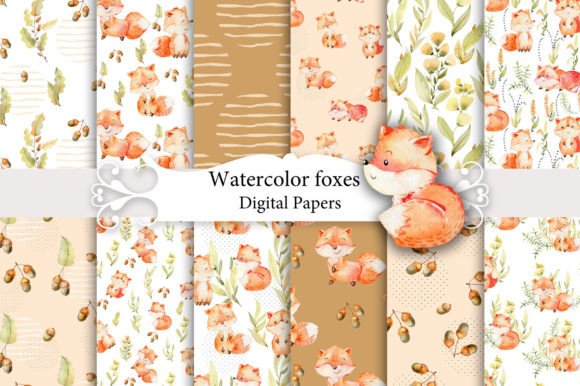
Imagine opening a digital kit and finding twelve rich, expressive watercolor fox motifs—each hand-painted with soft edges, subtle granulation, and gentle pigment blooms—designed not just as standalone illustrations, but as truly seamless, tileable patterns. That’s exactly what Seamless Patterns with Watercolor Foxes delivers: professional-grade digital papers built for real creative work, not just pretty previews.
Why Seamless Matters—Beyond the Buzzword
A “seamless” pattern isn’t just marketing language—it’s functional precision. With these files, you can repeat any of the 12 JPEGs edge-to-edge without visible joins, gaps, or misaligned elements. No tedious cloning, no guesswork in Photoshop’s Pattern Overlay, no awkward white lines when scaling for large-format prints. Each file is sized at 4800×4800 pixels (16×16 inches at 300 DPI), giving you serious resolution headroom—whether you’re printing a 24×36″ wall art piece or shrinking the same pattern down to a 2″ fabric swatch for baby onesies.
The watercolor texture remains intact across repeats because the brushstrokes, pigment diffusion, and fox silhouettes were intentionally composed to flow across boundaries. You’ll notice how ears, tails, and paw prints gently cross tile edges—not cut off, not mirrored, but naturally continuing. That subtlety makes all the difference in high-end applications like stationery or apparel, where amateur tiling often gives away low-effort design.
What Makes These Fox Patterns Stand Out
These aren’t cartoonish or overly stylized foxes. They’re rendered with authentic watercolor behavior: soft washes in burnt sienna and dusty rose, delicate negative space around snouts and paws, faint salt textures in the background washes, and varied fox poses—some curled, some alert, some mid-gallop—all unified by consistent light direction and paper tone.
Each pattern balances density and breathability. Some feature tightly clustered foxes for bold textile impact; others use generous spacing and lighter washes, ideal for subtle notebook linings or watermark-style overlays in presentations. The color palette leans into natural, muted earth tones—no neon, no oversaturation—so they pair effortlessly with letterpress invitations, organic cotton labels, or minimalist educational worksheets.
Real Creative Work, Real Use Cases
For makers and small businesses: Print these directly onto fabric for limited-run scarves or tote bags—no need for complex repeat software. Use one pattern as a background for product packaging mockups, then switch to another for social media banners, keeping your brand’s visual language cohesive but fresh.
In education and publishing: Teachers print them on cardstock for themed learning centers—fox-patterned flashcards for phonics, or science unit headers about forest ecosystems. Publishers use them as endpaper designs for children’s books or as textured backgrounds behind illustrated chapter openers—adding warmth without competing with line art.
For digital creators: Import into Canva, Affinity Designer, or Adobe Express as custom pattern fills. Layer a low-opacity fox pattern under typography for Instagram quote posts—it adds depth without sacrificing readability. Or drop one into Procreate as a canvas texture for hand-lettering practice, letting the watercolor grain subtly influence stroke weight and flow.
Scrapbookers and journalers: These scale beautifully. Tile one pattern across a full 12×12 scrapbook page, or crop a single fox motif to use as a focal element beside photos. Because they’re JPEGs—not vectors or layered PSDs—they load instantly, even on older devices, and embed cleanly into PDF planners or printable sticker sheets.
Practical Tips Before You Start Designing
Test tile behavior first—even with seamless files, monitor calibration and export settings can affect how edges align. Open one JPEG in your editor, duplicate the layer, and nudge it exactly 4800px right or down. Zoom in at 200% to verify continuity. If you see a faint seam, it’s likely a viewer or export artifact—not the file itself.
When using for apparel, always check your printer’s minimum repeat size. Many DTG (direct-to-garment) services require patterns to be at least 12×12 inches; these exceed that at 16×16, so you’re covered. For sublimation on mugs or phone cases, flatten the pattern into a single high-res JPEG before uploading—no transparency issues, no layer confusion.
If you plan to recolor—say, shifting a warm-fox pattern to cooler greys for a gender-neutral baby collection—do it non-destructively. In Photoshop, use Hue/Saturation adjustment layers set to “Colorize.” In Affinity, apply Recolour Adjustment with “Preserve Luminosity” enabled. That keeps the watercolor texture’s integrity intact while changing mood.
Not Just Another Digital Kit—A Thoughtful Creative Tool
What separates Seamless Patterns with Watercolor Foxes from generic clipart bundles is intentionality at every stage: the pigment choices, the fox anatomy studies behind each pose, the deliberate spacing for tiling, and the decision to deliver only JPEGs—removing compatibility friction for users who don’t own Illustrator or don’t want to wrestle with SVG imports.
You’re not buying twelve images—you’re acquiring twelve starting points. One pattern might become the lining of a handmade journal; another, the unifying visual thread across a boutique’s seasonal email series; another, the calming backdrop for a mindfulness coloring app interface. Their versatility lies in their restraint: they suggest, rather than shout. They support your voice, instead of overriding it.
And because they’re designed for reuse—not just one-off projects—they pay for themselves fast. A single pattern used across business cards, website headers, and product tags creates instant brand recognition. Reusing the same fox motif across baby clothes, nursery wall decals, and milestone photo props builds emotional continuity for customers.
If you’ve ever spent hours trying to fake a seamless repeat—or compromised on resolution to get a “cute fox” image that actually works across mediums—this kit solves that quietly, reliably, and beautifully. It doesn’t replace skill. It removes friction. And in creative work, that’s often the most valuable thing you can offer yourself.
Questions? Just send a message—we’re here to help you get the most out of these patterns, whether you’re designing your first Etsy listing or launching a full lifestyle brand.