Retro Digital Papers: 80s & 90s Patterns
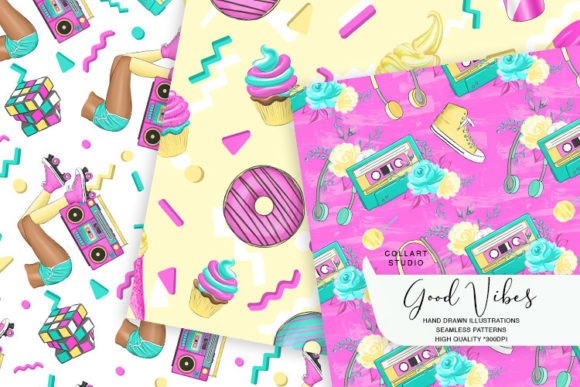
There’s a reason vintage aesthetics keep resurfacing—not as nostalgia for its own sake, but because bold 80s geometry, playful 90s textures, and hand-crafted imperfection carry real communicative power. Retro Digital Papers, 80s, 90s Patterns aren’t just visual throwbacks; they’re functional design assets grounded in authenticity. Each paper is one of a kind—hand drawn and painted by Collart Studio, then digitized at true high resolution (300 dpi, 12×12 inches). That means no tiled repeats, no algorithmic gradients, and no stock-art sterility. What you get are three original digital papers with tangible texture, intentional contrast, and subtle variations that only human hands produce.
Why hand-drawn retro patterns hold up where generic ones don’t
When you're designing a wedding invitation, launching a small-batch product line, or building a brand identity for a creative business, consistency matters—but so does character. Mass-produced seamless patterns often flatten personality. In contrast, these Retro Digital Papers, 80s, 90s Patterns retain the slight irregularity of ink lines, watercolor bleed, and layered brushstrokes. That nuance reads as warmth and intentionality to viewers—even subconsciously. A planner sticker made from one of these papers doesn’t just look “vintage”; it feels considered, tactile, and human-made. That distinction builds trust, especially with audiences aged 25–45 who increasingly favor authenticity over polish.
Practical uses that go beyond decoration
These papers work hardest when treated as foundational elements—not just backgrounds, but structural tools. For example:
- Planner stickers: Because each paper is 12×12 inches at 300 dpi, you can scale down individual motifs without pixelation—or extract sections to create cohesive sticker sets with matching grain and tone. No more mismatched clipart from different sources.
- Web and blog design: Use them as subtle CSS background repeats (with opacity adjustments) for section dividers or newsletter headers. Their organic density avoids the “busy” effect common with rigid geometric tiles.
- Scrapbooking and decoupage: Print directly onto matte cardstock or specialty decoupage paper—the hand-painted texture translates beautifully to physical layers, adding depth without extra embellishment.
- Invitations and cards: Layer a scanned handwritten note over a softened Retro Digital Paper, 80s, 90s Pattern background. The contrast between analog script and curated vintage texture reinforces sincerity and effort.
They’re also adaptable across mediums: fabric printers handle the 300 dpi resolution cleanly, and cutting machines like Cricut recognize clean vector-ready edges when you isolate elements using clipping masks in design software.
Who benefits most—and why timing matters
Freelancers building client portfolios, educators designing classroom resources, small business owners launching seasonal collections, and bloggers curating visual tone all gain measurable efficiency here. Consider a freelance graphic designer preparing three mood boards for a retro-themed café rebrand. Instead of spending hours sourcing, licensing, and editing disparate assets, they start with these three coordinated papers—each distinct in rhythm and palette but unified by Collart Studio’s hand-drawn sensibility. That saves 2–3 hours per project, and more importantly, ensures visual cohesion clients notice immediately.
Hobbyists and DIY creators benefit too—but differently. If you’re making handmade greeting cards for a local craft fair, having access to original, non-clipart-based patterns means your work stands out on crowded tables. Buyers respond to uniqueness they can *feel*, even in printed form. These Retro Digital Papers, 80s, 90s Patterns give you that edge without requiring illustration skills.
What to keep in mind before using them
These aren’t “plug-and-play” templates with built-in text boxes or pre-sized layouts. They’re raw, high-fidelity design surfaces—intentionally flexible, but requiring basic familiarity with tools like Adobe Photoshop, Affinity Designer, or even Canva’s advanced upload features. If you’re new to digital design, plan for 20–30 minutes of exploration: try adjusting blend modes (Multiply works well over light type), applying subtle Gaussian blur for soft overlays, or using layer masks to reveal portions selectively.
Also, while the 12×12 inch size supports most standard print needs—from A4 to 12×12 scrapbook pages—it’s not ideal for ultra-narrow applications like narrow washi tape designs without careful cropping. And because they’re hand-painted originals—not algorithmically generated—exact color matching across devices may vary slightly. Always soft-proof in your intended output environment (e.g., sRGB for web, CMYK for professional printing).
How they support long-term creative sustainability
Many designers cycle through trend-driven assets, only to find them dated within months. Retro Digital Papers, 80s, 90s Patterns sidestep that trap by anchoring trends in technique, not just era. The 80s influence isn’t just neon—it’s asymmetrical balance and confident scale. The 90s nod isn’t just grunge—it’s collage sensibility and mixed-media layering. That makes them surprisingly versatile across contexts: a paper with chunky linocut-style shapes reads equally well on a modern tech startup’s event poster or a teacher’s classroom reward chart.
Plus, owning three original papers means you’re not relying on subscription libraries or risking license changes. You can use them indefinitely—across client work, personal projects, or commercial products—without renewal fees or attribution requirements (though crediting Collart Studio is always appreciated).
A note on seeing the details
Since texture and brushwork define these Retro Digital Papers, 80s, 90s Patterns, clicking “Zoom” on product images isn’t optional—it’s essential. What looks like solid color at thumbnail size reveals granular pigment variation, faint pencil underdrawing, or deliberate dry-brush strokes at full resolution. That’s where the real utility lives: in the micro-details that make digital feel handmade.
Final thought: quality over quantity, every time
You don’t need dozens of patterns to build a strong visual language. Three thoughtfully made, hand-drawn papers—each with its own voice, weight, and rhythm—offer more strategic value than fifty generic tiles. They encourage restraint, intention, and editing: choosing the right paper for the message, not just the prettiest one. Whether you’re illustrating a children’s book cover, designing limited-edition planner inserts, or developing a textile line, these Retro Digital Papers, 80s, 90s Patterns serve as both foundation and finish—quietly elevating work without shouting for attention.