Funny Dogs Digital Papers and Patterns
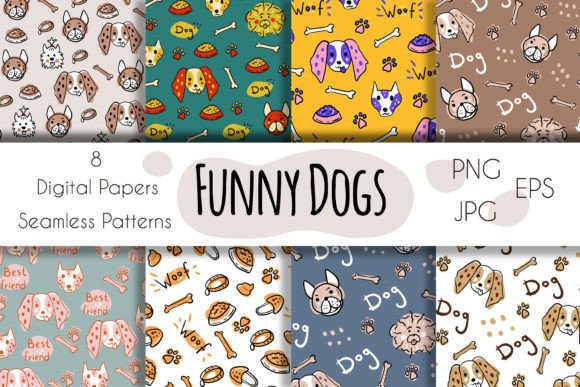
Imagine opening a zip file and finding eight vibrant, hand-drawn dog patterns—each one bursting with personality, playfulness, and precision. That’s what Funny Dogs Digital Papers and Patterns delivers: a cohesive, high-resolution collection designed not just to decorate, but to empower real creative work. These aren’t generic clipart or overused stock motifs. They’re original doodle-style illustrations—think floppy ears, wagging tails, paw prints, bones, and bow ties—all arranged into seamless repeats that scale beautifully across surfaces, formats, and audiences.
Each of the eight patterns comes in three formats—PNG (with transparent background), JPG (for quick use), and EPS (vector for infinite scalability)—all sized at 3600 × 3600 pixels (12×12 inches) and rendered at 300 dpi. That means whether you're printing fabric for a boutique pet collar line or designing Instagram story templates for a dog-walking business, clarity and fidelity stay intact. No pixelation. No awkward seams. Just consistent, joyful canine energy ready to integrate into your workflow.
Where These Patterns Shine Most
Designers and small business owners often face a tension: find assets that feel unique *and* function reliably across multiple outputs. Funny Dogs Digital Papers and Patterns bridges that gap. Because the collection is built around a unified doodle aesthetic—loose yet intentional, colorful but not chaotic—it holds together whether used on a greeting card or a tote bag. That visual consistency helps build brand recognition without demanding custom illustration time.
For textile designers, these papers translate directly to fabric swatches. Try layering one pattern as a base print and using another as an accent motif on pocket flaps or lining. For stationery makers, pair a subtle bone-repeat background with bold typography for birthday invitations—or reverse it: use a busy pattern as a border and keep the center clean for handwritten notes. Educators crafting classroom rewards can print paw-print paper for “Good Paw” certificates; pet bloggers can embed a pattern into Canva templates for weekly newsletter headers.
Real Projects, Real Outputs
Here’s how creators are already putting this collection to work:
- Pet product packaging: A Portland-based leash company uses the “Doodle Dachshund Dash” pattern as a wrap-around band on kraft boxes—paired with matte black foil stamping for contrast. The result feels handmade but professional.
- Kids’ craft kits: A homeschool supplier prints the “Puppy Party” pattern onto cardstock sheets, then pre-cuts them into shapes for sticker-making, collage, and DIY puppets. The seamless repeat ensures no wasted space during cutting.
- Social media assets: A freelance pet photographer overlays a low-opacity version of the “Bones & Barks” pattern behind client testimonials on Instagram carousels—adding warmth without competing with faces or text.
- Scrapbooking and decoupage: One Etsy seller combines two patterns—one as a background paper, another cut into layered die-cut elements—to create dimensional photo mats for dog adoption announcements.
What makes these applications successful isn’t just the cuteness factor—it’s the technical readiness. Seamless tiling means no manual alignment. High-res files mean crisp printing up to poster size. Transparent PNGs allow non-destructive blending in Photoshop or Procreate. And because all eight patterns share the same color palette and line weight, mixing them feels intuitive—not jarring.
Adapting Across Audiences and Platforms
A children’s book illustrator might isolate individual doodles from the EPS files to redraw them as character sprites. A Shopify store owner could upload the JPGs directly into their theme editor as section backgrounds—no designer needed. A teacher preparing a “Dog Safety Week” unit might export one pattern as a PDF handout grid and another as a classroom door decoration JPEG.
The key is intentionality: ask *what job does this pattern need to do?* If it’s for digital use (websites, social posts), JPG or PNG works best—optimize file size without sacrificing clarity. If it’s for physical production (fabric, stickers, signage), lean on EPS for vector flexibility or PNG for transparency. For print-heavy workflows like greeting cards or wrapping paper, always preview at 100% zoom before sending to press—these files hold up, but soft proofing prevents surprises.
Maintaining Clarity and Cohesion
When working with playful assets, it’s easy to over-layer or over-decorate. Keep results effective by limiting pattern density: use one dominant pattern per piece, then add contrast through typography, shape, or negative space—not more patterns. For example, a birthday invitation might feature the “Wagging Wonders” repeat as a subtle watermark behind clean sans-serif text. Or a fabric design could spotlight one central doodle (like a sleeping corgi) against a quiet version of the same pattern, scaled down 30%.
Also consider audience tone. A vet clinic’s holiday card benefits from warmth and approachability—so the “Sniff & Smile” pattern works well at medium scale. A streetwear brand launching a limited dog-themed hoodie line might crop and rotate elements from the “Paw Parade” pattern into a bold, asymmetrical layout—keeping the spirit while elevating edge.
Finally, remember licensing: this collection is intended for both personal and commercial use—including physical products and digital distribution—so long as end files aren’t resold as standalone digital assets. That freedom lets educators print unlimited copies, makers sell finished goods, and marketers run ad campaigns—without legal second-guessing.
At its core, Funny Dogs Digital Papers and Patterns isn’t about filling space. It’s about giving creators reliable, expressive tools that spark ideas *and* ship projects. Whether you’re sketching a concept, prepping a print run, or building a brand identity for your pet-sitting service, these papers meet you where you are—with tail wags, not complications.